Showing posts with label go. Show all posts
Showing posts with label go. Show all posts
Sunday, September 13, 2009
The Teaching Game
I was taking a nap one day and somewhere in the middle of it, as I drifted between states of consciousness, I heard the sweet sound of Yunzi stones snapping on a bamboo board. Now I'm not 100% sure I heard this correctly, but on the edge of my consciousness I heard Richie reviewing a part of a game with Alyssa. He was saying, and I quote, "in this situation you could just play here, because then I go here, and you connect here." I'm a little vague on the exact wording but I'm sure about the vocabulary used. I recall thinking "situation" is a strange word for him to be using (I've never heard it from him before), and realized he must be mimicking my own review language. But as I enjoyed the moment, wishing to somehow stop time or bottle up the scene somehow, I soon fell back to sleep. When I awoke, Richie told me he played a 9 handicap game with Alyssa and lost. I said 9 stones is too many for a 13x13 board, but he was said "yeah, but I invaded all over the place, and I could have won."

Tuesday, September 1, 2009
Feng Yun Summer Go Workshop
 Last week we attended the Feng Yun Summer Go Workshop in Somerset, NJ. I had noticed an announcement in the American Go Association E-Journal mentioning the workshop and decided to attend with my family on a whim. Overall, I was pleasantly surprised. There are comparatively few opportunities for young players (or adults, for that matter) to play go and get exposure to strong players for instruction so I was really looking forward to having Richie & Alyssa get a proper beginner's introduction to the game. Having a chance to learn something myself was an added bonus. I was a little concerned that the attendence might be low, but the turnout was actually pretty healthy. There were over 20 players in attendence, and importantly, there were at least 7 that were about the same age as our kids, most of whom were absolute beginners. I was a little surprised that I was only one of two adults in attendence, but the healthy number of (mostly Chinese) kids, really added to the fun for our children who had an absolute blast running around the hotel with the other kids in between lessons.
  The daily schedule was intensive but manageable even for the young ones. All meals are included and prepared in the hotel, which definitely streamlines the go experience. Each day after breakfast there was a 3 hour instructional session from 9-12pm, followed by lunch, a 2nd session from 1 to 4pm, an afternoon physical activity break from 4-6pm, followed by dinner and an evening session from 7-9pm. At first I thought this heavy a schedule would be too difficult and that our kids would get tired or restless, but surprisingly they had plenty of energy and seemed to enjoy even the late evening session.
The group was divided into 3 sections--a dan level group, a kyu group and a beginner group--and the activities were different for different groups. For the kyu players, usually the morning and afternoon session consisted of initial instruction (either a game review or solving problems) followed by an hour of ladder tournament games which continued all week. The dan level players spent most of their time playing teaching games with the visiting Chinese pro, Xue Lei 4p, who played 3-4 players simultaneously.
As a side note, I was surprised to find out that the Xue Lei had no problem playing several games simultaneously *and* could recall any particular game accurately hours or even a day later. All of the dan players could more or less remember their games as well.
 I was especially interested in how the beginners were instructed and was pleased to find out that Feng Yun herself, a 9-dan professional player, actually taught around half of the beginner sessions while the rest were taught by Paul Matthews, himself a strong amateur player. Each of the beginners was given a book of problems which looked like material from a Chinese go instructional program. It consisted of an introduction to the rules of go, a few sections of basic problems (without answers), and a few sample openings. There were conceptual sections (corners, sides, center), meaning of the different lines, etc. and I was not that surprised to find out that it was very similar to the Korean books I recently purchased. The main differences seemed to be that the Chinese book was a little less entertainment focused (no cartoons), and had more exercises per section. Their lessons varied between working through the workbooks, playing each other, and playing handicap games.
I found out that the operator of the hotel is a go enthusiast and parent and had generously reduced the hotel rates which explains how the cost could be so low. At around $300 per person, including accommodation and meals for 5 days, the workshop certainly offers excellent value. The cost varies depending on whether you will need your own room or can double up with other attendees, but either way it's a bargain.
 Probably the most difficult aspect of such a workshop (which it turned out was mainly for young players) is to balance serious study with fun. In my case, with such young children, I was only looking for them to have a better idea of how the rules of the game worked and some basic, beginner strategy. By far the most important thing was for them to like playing go and enjoy themselves. For some of the older children, some of the time, there were a few very minor discipline issues along the way, but overall I felt the right balance was maintained quite admirably.
I suppose the strongest endorsement of all comes from Richie & Alyssa who were both sad to leave. Richie wanted to know why we couldn't stay longer and Alyssa has said that she would like to come again.
It's too early for me to say if we'll be able to attend any of the upcoming workshops (which are held twice a year) but I certainly hope we can.
Friday, August 14, 2009
Gludion in Blogger
I got gludion working in blogger! Sweet. It wasn't as hard as I thought it would be. All credit to this flash tutorial which pointed the way for me, except the google site maker they used is no longer current.
For anyone that wants to do this yourself, here are the steps I used.
1. I created a page on Google Sites. This is where I uploaded the executable swf file and sgf files.

2. Download Gludion. The only file you need is the file goswf.swf.
3. Use the menu in the upper right of Google sites to "manage the site" and on the left had sidebar there is an option to upload attachments. Upload the goswf.swf file and an sgf file.

4. In blogger, or presumably anything similar, you can embed the player using html like this:
And Presto!
For anyone that wants to do this yourself, here are the steps I used.
1. I created a page on Google Sites. This is where I uploaded the executable swf file and sgf files.

2. Download Gludion. The only file you need is the file goswf.swf.
3. Use the menu in the upper right of Google sites to "manage the site" and on the left had sidebar there is an option to upload attachments. Upload the goswf.swf file and an sgf file.

4. In blogger, or presumably anything similar, you can embed the player using html like this:
<embed src="http://sites.google.com/site/kidschessandgo/goswf.swf"
flashVars="c0=#83E9F3&c1=#E5E5E5&c2=#AABBAA&url=wanhychen-Hisashi.sgf" quality="high" allowscriptaccess="always"
type="application/x-shockwave-flash" pluginspage="http://www.macromedia.com/go/getflashplayer"
align="middle" height="400"
width="400"></embed>
And Presto!
Friday, October 31, 2008
Video: a new frontier for Kids Chess and Go
We recently got a DXG-567V HD handheld video recorder. It's pretty neat and I may do a separate review later. The best thing about it is that it's really small and convenient to use. I perched it from the overhead light in our dining room and captured this short video of Richie playing Go with me. As an added bonus if you listen carefully you'll hear Alyssa practicing piano in the background. I even signed up on YouTube to host the video. I feel so proficient.
Thursday, September 4, 2008
Single Digit Kyu
Apparently I've officially crossed the threshold to single digit kyu (SDK) on KGS. It's taken me almost 10 months (less a 2 month break).

I thought I would outline on this occasion some of the things that I thought were most helpful to me on my way up the ranks.
26k to 20k -- I played against the computer on 9x9 go. I was fairly quickly able to get to the point where I could win with a 2 stone handicap.
20k to 16k -- I started to play 19x19 go on KGS. Many of my early games were very peaceful set-ups with each player mapping out huge moyos then turning them into territory then failing at invasion.
16k to 14k -- Around this time I got my first go books: Fundamentals of Go by Kageyama and Janice Kim's Learning Go Series. Both of these were very helpful. I began applying some opening concepts like: play in open corners, enclose, extend. I still could not invade anything but a huge moyo and would often lose entire groups in the corner. Most of my improvement came from just playing a lot of games, over a hundred in the first few months. Mainly I learned a little bit about ladders and some basic concept of making enough space to make eyes.
14k to 12k -- I picked up some more books. The most useful at this time were Tesuji by Davies, and Attack and Defense. Much of my improvement here came from getting a little better at local fighting, a little better at life and death in the corner, and I started preventing my opponent from getting large territory through reduction and invasion.
12k to 11k -- Here I think the most important thing I learned was a little bit more about opening theory, I experimented with moyo type openings. My middle game improved a little and I learned to take indirect profit from attack, how to make more optimal extensions. I would credit most of my strategic improvement to Audio Go Lessons, where I took the full beginner course and many others just for fun. I would especially recommend the lessons on how to attack by Jennie Shen and of course Go Juan's lessons for beginners.
11k to 10k -- I think I got a little better at middle game play here and my opening improved a little. I also read Get Strong at Invasion. I also played several 9 stone handicap games with a dan player and tried to study ways to make use of the handicap stones properly.
10k to 9k -- I felt I got a little better at using thickness properly and became a little more flexible in my game plan. I make slightly better choices about whether to emphasize territory or influence. I am getting a little better at finding big end game moves and getting a little better at playing sente moves when it matters. I am now better able to appreciate pro games and currently am studying Invicible (a Shusaku game collection).
There is so much more to Go than what I know now. It will be interesting to see how I develop from here.

I thought I would outline on this occasion some of the things that I thought were most helpful to me on my way up the ranks.
26k to 20k -- I played against the computer on 9x9 go. I was fairly quickly able to get to the point where I could win with a 2 stone handicap.
20k to 16k -- I started to play 19x19 go on KGS. Many of my early games were very peaceful set-ups with each player mapping out huge moyos then turning them into territory then failing at invasion.
16k to 14k -- Around this time I got my first go books: Fundamentals of Go by Kageyama and Janice Kim's Learning Go Series. Both of these were very helpful. I began applying some opening concepts like: play in open corners, enclose, extend. I still could not invade anything but a huge moyo and would often lose entire groups in the corner. Most of my improvement came from just playing a lot of games, over a hundred in the first few months. Mainly I learned a little bit about ladders and some basic concept of making enough space to make eyes.
14k to 12k -- I picked up some more books. The most useful at this time were Tesuji by Davies, and Attack and Defense. Much of my improvement here came from getting a little better at local fighting, a little better at life and death in the corner, and I started preventing my opponent from getting large territory through reduction and invasion.
12k to 11k -- Here I think the most important thing I learned was a little bit more about opening theory, I experimented with moyo type openings. My middle game improved a little and I learned to take indirect profit from attack, how to make more optimal extensions. I would credit most of my strategic improvement to Audio Go Lessons, where I took the full beginner course and many others just for fun. I would especially recommend the lessons on how to attack by Jennie Shen and of course Go Juan's lessons for beginners.
11k to 10k -- I think I got a little better at middle game play here and my opening improved a little. I also read Get Strong at Invasion. I also played several 9 stone handicap games with a dan player and tried to study ways to make use of the handicap stones properly.
10k to 9k -- I felt I got a little better at using thickness properly and became a little more flexible in my game plan. I make slightly better choices about whether to emphasize territory or influence. I am getting a little better at finding big end game moves and getting a little better at playing sente moves when it matters. I am now better able to appreciate pro games and currently am studying Invicible (a Shusaku game collection).
There is so much more to Go than what I know now. It will be interesting to see how I develop from here.
Sunday, August 31, 2008
Ponnuki Go
In the last few days I've experimented with playing Ponnuki-Go AKA Atari-Go as a learning method with my children (and wife). See Sensei's Library here for more information. Basically this is a stripped down version of Go, which has only the capture rule: i.e. if a stone or group of stones is completely surrounded it is captured. The first player to capture N stones (I used N=1) is the winner. There is some controversy in the go community as to whether or not this is a good teaching method. On one hand it is simple to understand even for very young children, it leads to quick games with no need for counting, it has more understandable and concrete goals so strategy is simpler to grasp, etc. On the other hand it tends to produce players who are pre-occupied with capturing which may become an hindrance to proper development later when making the transition to "real" go.
I suppose I personally subscribe to the view that it is fine to learn Go in stages. It's more important for young children to enjoy playing and trying to explain "eyes", eye-space, false eyes, ko rule, snap-back, along with some strategic notions can become overwhelming. Ponnuki-go is a very natural game to be playing on a go board with stones so I can see little harm in trying it out.
After a few quick games where my kids missed defending against atari (threatening to capture in one move), they quickly got the hang of things. They were still apt to make judgement errors which left them with an easily captureable weak stone (most often by playing "underneath" my stones in an attempt to capture something). But on the whole I was pretty pleased with how this version of the game taught them to make some basic extensions and other defensive moves.
Contrary to the concerns addressed earlier, I found that they were beginning to understand the value of staying connected. This is a concept which I had difficulty explaining during my earlier attempts to teach them "regular" go where they were focused on trying to surround territory. In my experience, getting good at staying connected is probably more essential to early development than learning how to efficiently surround territory. I don't have any real justification for that, it's just my impression based on my current level (around 10k).
Here's a game I just played with Alyssa where she capitalized on a reading error on my part. Much to my surprise she actually said "I win, thanks" as soon as I made the losing move, which implied that she was reading two moves ahead. Just for clarity, I did allow her to take back several moves along the way and also suggested some moves early on (such as defending with a 1 point jump or knight's move and not allowing me to easily cut her stones.
Unfortunately I don't have a way to display a 13x13 game so this is on a 19x19 board display. The borders of the game would be the lines attaching the 4,4 handicap points in all four corners.
I suppose I personally subscribe to the view that it is fine to learn Go in stages. It's more important for young children to enjoy playing and trying to explain "eyes", eye-space, false eyes, ko rule, snap-back, along with some strategic notions can become overwhelming. Ponnuki-go is a very natural game to be playing on a go board with stones so I can see little harm in trying it out.
After a few quick games where my kids missed defending against atari (threatening to capture in one move), they quickly got the hang of things. They were still apt to make judgement errors which left them with an easily captureable weak stone (most often by playing "underneath" my stones in an attempt to capture something). But on the whole I was pretty pleased with how this version of the game taught them to make some basic extensions and other defensive moves.
Contrary to the concerns addressed earlier, I found that they were beginning to understand the value of staying connected. This is a concept which I had difficulty explaining during my earlier attempts to teach them "regular" go where they were focused on trying to surround territory. In my experience, getting good at staying connected is probably more essential to early development than learning how to efficiently surround territory. I don't have any real justification for that, it's just my impression based on my current level (around 10k).
Here's a game I just played with Alyssa where she capitalized on a reading error on my part. Much to my surprise she actually said "I win, thanks" as soon as I made the losing move, which implied that she was reading two moves ahead. Just for clarity, I did allow her to take back several moves along the way and also suggested some moves early on (such as defending with a 1 point jump or knight's move and not allowing me to easily cut her stones.
Unfortunately I don't have a way to display a 13x13 game so this is on a 19x19 board display. The borders of the game would be the lines attaching the 4,4 handicap points in all four corners.
Wednesday, July 23, 2008
Go in New York City and Stamford, CT
For a couple of months now I have been semi-regularly attending the classes of the IgoAmigo Go Club/School. I mentioned in a previous post that I accidentally stumbled into one of their classes at the New York Go Center on my first visit. I had originally thought that it was part of the NYGC, but actually it's a completely separate organization. They used to meet twice a month on Saturdays at the NYGC, but due to some disagreements with the NYGC (I don't really know the details) they have moved their class to Columbia University. It's really a shame that in the small circle of NY Go players, it's not possible to reach some sort of amicable solution that would enable the club to meet at the only dedicated go facility in the city. At any rate, I have decided for the time being to try to continue attending.
If anyone is interested in attending, the daily fee is still going to be $7, I believe. The teachers are 7d and 1d. Most attendees are Japanese but there are also English speakers and both teachers speak English fairly fluently.
I also am on the brink of finding some players to play with in the Stamford area. I have been looking for an opportunity to play in person somewhere around my home to no avail. Last Saturday, I randomly dropped by Starbucks in Stamford, near the Ferguson Library and came across a few chess players. I had my laptop and a book on Go which I started reading. One of the players noticed and asked if I played a lot. I learned that he was close to my level (he said 10k) and that he had a friend that was looking for people to play with. Another kid there said he used to play with his mother when he was young but didn't play anymore. Well, counting myself, the guy and his friend, the kid and his mother, and one other acquaintance, I know of 6 Go players in the Stamford/Greenwhich area. It also turns out that the 7d player from IgoAmigo also lives in Rye which is not too far.
I have also been exchanging mails with a guy named Mark, who also has a daughter near the age of Alyssa and a Go Blog. He lives in CT, but a bit far so it's unlikely I will be able to play him, but one can hope.
It would be awesome to play in Stamford so I am going to start hanging out at the Starbucks in my free time to try to stimulate some local interest. I think I'll need to hang a sign out that says "Ask me to Teach You, 5 minutes to Learn, a Lifetime to Master" or something like that.
If anyone is interested in attending, the daily fee is still going to be $7, I believe. The teachers are 7d and 1d. Most attendees are Japanese but there are also English speakers and both teachers speak English fairly fluently.
I also am on the brink of finding some players to play with in the Stamford area. I have been looking for an opportunity to play in person somewhere around my home to no avail. Last Saturday, I randomly dropped by Starbucks in Stamford, near the Ferguson Library and came across a few chess players. I had my laptop and a book on Go which I started reading. One of the players noticed and asked if I played a lot. I learned that he was close to my level (he said 10k) and that he had a friend that was looking for people to play with. Another kid there said he used to play with his mother when he was young but didn't play anymore. Well, counting myself, the guy and his friend, the kid and his mother, and one other acquaintance, I know of 6 Go players in the Stamford/Greenwhich area. It also turns out that the 7d player from IgoAmigo also lives in Rye which is not too far.
I have also been exchanging mails with a guy named Mark, who also has a daughter near the age of Alyssa and a Go Blog. He lives in CT, but a bit far so it's unlikely I will be able to play him, but one can hope.
It would be awesome to play in Stamford so I am going to start hanging out at the Starbucks in my free time to try to stimulate some local interest. I think I'll need to hang a sign out that says "Ask me to Teach You, 5 minutes to Learn, a Lifetime to Master" or something like that.
Friday, February 1, 2008
3 Month Update on Dad's Go Progress
 Well if KGS rank has any meaning, it seems that I managed to improve slightly since last month. I am now barely 12k online which surprises me because I remember thinking a month or two ago that most of the games I had with 12k were hopelessly one-sided. In fact I don't think I actually won many games against higher ranked players, but I've become more consistent about winning against 14k and lower so I guess that's improved my rank some.
 Shamefully, I have less motivation to actually study anything or do tsumego problems while my rank is still progressing just from games. I did pick up a copy of Fundamentals of Go by Kageyama which is a nice book that I would recommend highly. I like his conversational style and I found his examples to be quite interesting and enlightening. The unusual thing about this book is that many of the reviews of the book suggested that it is useful to read several times at different stages. Essentially reviewing this book helped a lot of people get over developmental blocks at successively higher levels of strength. They made comments which in effect said that the material is basic enough for someone like me or around mid-teens kyu to get something out of, but when you are much stronger, you can come back to the same exact material and find deeper insights still.
I especially liked the emphasis he puts on reading. I have to admit that I am sometimes lazy over the board and play many moves based on my meager intuitive grasp, when if I just sat and concentrated I could probably read out a solution.
 In a game today against a 14k, I recalled specifically the first lesson in his book which requires reading out a ladder across the board. I had a similar situation in this game where I had a center facing stone caught in a ladder. I played an approach to the upper left corner which I had read out to be a ladder break. But my opponent failed to realize the ladder break was in place and proceeded to chase me for about 10 moves in a broken ladder. Of course, once he realized his error, his entire game fell apart as my diagonal thickness and his excess aji were too much to overcome. He resigned shortly afterwards.
Thursday, January 3, 2008
2 Month Update on Dad's Go Progress

My pace of improvement at Go has clearly slowed. There's fewer easy fixes to my game. My losses are coming less and less from close-fighting blunders or forgetting to connect some group and more from strategic lapses so it's harder to make improvement form just playing. I bought Kageyama's Fundamentals of Go and I'll be trying to work through that book. I am also still periodically working on Go Dojo. I went through Contact fights and now I'm working on Sector fights, although on this first pass, I'm really just browsing the material, rather than studying it. It's sort of the way I used to study math. I'm more curious what there is to learn than actually interested in learning it. It seems in Go, though, that progress without sweat is an impossibility so I'm going to have to buckle down if I really want to improve. I am now around 14k on KGS. I think my experience is not too dissimilar from some others that started around the same time as I did. It will be interesting to see where we hit our walls.
An area that I could definitely improve on is the opening. I'm not exactly sure how Go compares to chess in terms of the number of 'rote' openings one needs to know. I think it's a much wider game tree, but there are 'building blocks' of opening joseki or standard sequences that you sort of fit together to form opening plans, it seems. Of course, I'm just sort of winging it right now but when I play GnuGo I routinely get trashed in the first 15 moves so there's probably some work to be done there.
Tuesday, December 18, 2007
How kids think about Go
Lately, Richie and Alyssa have been taking interest in Go again. After a brief respite where Richie only wanted to play chess, in the last few days we've played at least 1 game of go a day and I've also seen them playing each other.
Go is a simple game to explain the rules to, so they basically know how to play already, and I think they even know the concept of Ko now, as well as how to score the game. They like to play on the 19x19 side of the board. I guess even kids have pride and think that the 9x9 game isn't the real thing.
But as anyone who plays the game knows, the strategic aspect of Go is very deep, and it's hard to know how to start explaining it.
Without any instruction from me, I noticed two tendencies of their play that needed to be addressed: 1) too much focus on capturing/contact and not enough almost no attention paid to making territory and 2) no concept of efficiency of play, or preferring solid structures.
I think some of the first problem I was able to address by showing them several times how we count points at the end and after I demonstrated a few times that a 2-point jump, for instance, could surround territory faster than solid connections and was just as difficult to break into.
Initially they had difficulty understanding that the opponent couldn't just cut through the space made by the jump, but eventually I showed them some variations where they could wait to fill the space until I approached or tried to cut and still end up with a solid territory line. I called this "dot-to-dot" fence building. I said they should build fences using dot-to-dot and connect the dots later if someone came close. I admonished them not to play too close to the enemy since that ends up making the enemy stronger but I am having a difficult time explaining when conditions are good to attach. They also have a tendency to want to save stones that are dead but it's hard to explain why that is the case.
They were excited to learn to learn that there was a "knight's move" in Go as well as chess and that double-atari was like forking in chess too.
Go is a simple game to explain the rules to, so they basically know how to play already, and I think they even know the concept of Ko now, as well as how to score the game. They like to play on the 19x19 side of the board. I guess even kids have pride and think that the 9x9 game isn't the real thing.
But as anyone who plays the game knows, the strategic aspect of Go is very deep, and it's hard to know how to start explaining it.
Without any instruction from me, I noticed two tendencies of their play that needed to be addressed: 1) too much focus on capturing/contact and not enough almost no attention paid to making territory and 2) no concept of efficiency of play, or preferring solid structures.
I think some of the first problem I was able to address by showing them several times how we count points at the end and after I demonstrated a few times that a 2-point jump, for instance, could surround territory faster than solid connections and was just as difficult to break into.
Initially they had difficulty understanding that the opponent couldn't just cut through the space made by the jump, but eventually I showed them some variations where they could wait to fill the space until I approached or tried to cut and still end up with a solid territory line. I called this "dot-to-dot" fence building. I said they should build fences using dot-to-dot and connect the dots later if someone came close. I admonished them not to play too close to the enemy since that ends up making the enemy stronger but I am having a difficult time explaining when conditions are good to attach. They also have a tendency to want to save stones that are dead but it's hard to explain why that is the case.
They were excited to learn to learn that there was a "knight's move" in Go as well as chess and that double-atari was like forking in chess too.
Sunday, December 2, 2007
1 month update on Dad's Go progress
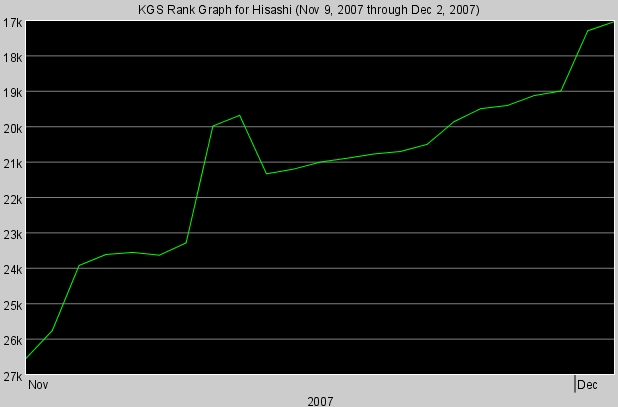
I wonder how far I'm going to get without learning any Joseki. I'm still at the point where I'm getting better just from playing games, without too much study. I used to frequently lose large groups because I wasn't staying connected and that's happening less frequently. I'm also starting to get a little better at keeping groups alive by making eyes I think. I've been watching a few of Guo Juan's audio lessons which are excellent. I highly recommend them. I think I'm on number 5 now in the beginner lessons. I enjoy watching them a lot which I guess means that's a good way for me to study.
Wednesday, November 28, 2007
Empty Triangle Comics
While on the subject of Go related entertainment, I thought I'd mention this strip which I found through ChiyoDad's blog. Empty Triangle is nice and I like the perspective of a novice (and a girl) in the Go world. Very well done. I wonder if I can commission the artist to do a drawing for my kids? They would definitely get a thrill out of that...
Hikaru no Go
One day while searching on Netflix for some cartoon movies to rent for the kids I came across the Hikaru no Go series. I knew almost nothing about Go at the time, though I did learn the basic rules when I was in high school. Since I never had anyone to play against, I had pretty much forgotten about the game until seeing this anime series. Strangely, Netflix didn't have the first disc available so I ended up starting with the second disk. My kids both really liked it as did I so I ended up just buying the series from Amazon. I really liked the way they dramatized all of the games and it had the nice effect of inspiring all of us to give the game a try. After having Chinese food in Flushing, NY one day I tried to drop by a local Baduk club. It wasn't very English friendly, unfortunately, but the proprietor was able to point me to a local Korean grocery store when I asked where I could buy a baduk board. We found the store without much trouble and picked up a cheap go board. I searched online to remind myself of the rules and went through the exercises on Hiroki Mori's site, the Interactive Way to Go.
I also used this teaching guide but it turned out that after watching Hikaru no Go, the kids had sort of picked up the rules already. I didn't bother explaining eyes, but they do manage to sort of play games. I actually found that using a chess board (9x9) in Go was the best balance. Much smaller than that and it doesn't seem to make a lot of sense and of course bigger than that is too much to handle for them. But at 9x9 I can play Alyssa with a 4 stone handicap and if I correct obvious mistakes where she misses that I'm about to capture a large group because she's failing to make an easy connection, she gives me a pretty good run for my money. It's surprising how easily they seem to grasp basic defensive plans. Strangely, enough they can play games with each other and (after correcting major oversights) Richie seems to usually get the upper hand over Alyssa. I've tried to teach them about scoring the game but they seem to lose sight of the goal of the game sometimes and will typically make "dead" moves near the end of the game as they start running out of open space to fill. They also seem to prefer building long walls and prioritize taking prisoners over taking space. Well anyway, I don't try to instruct them much, I'm just having them play as many games as I can right now.
 Richie and Alyssa both enjoy playing. We got in a few games over Thanksgiving at Ben and Christine's house.
I also used this teaching guide but it turned out that after watching Hikaru no Go, the kids had sort of picked up the rules already. I didn't bother explaining eyes, but they do manage to sort of play games. I actually found that using a chess board (9x9) in Go was the best balance. Much smaller than that and it doesn't seem to make a lot of sense and of course bigger than that is too much to handle for them. But at 9x9 I can play Alyssa with a 4 stone handicap and if I correct obvious mistakes where she misses that I'm about to capture a large group because she's failing to make an easy connection, she gives me a pretty good run for my money. It's surprising how easily they seem to grasp basic defensive plans. Strangely, enough they can play games with each other and (after correcting major oversights) Richie seems to usually get the upper hand over Alyssa. I've tried to teach them about scoring the game but they seem to lose sight of the goal of the game sometimes and will typically make "dead" moves near the end of the game as they start running out of open space to fill. They also seem to prefer building long walls and prioritize taking prisoners over taking space. Well anyway, I don't try to instruct them much, I'm just having them play as many games as I can right now.
 Richie and Alyssa both enjoy playing. We got in a few games over Thanksgiving at Ben and Christine's house.
Tuesday, November 27, 2007
Let there be light!
Let there be light!
1:1 - In the beginning God created the heaven and the earth.
1:2 - And the earth was without form, and void; and darkness was upon the face of the deep. And the Spirit of God moved upon the face of the waters.
1:3 - And God said, Let there be light: and there was light.
1:4 - And God saw the light, that it was good: and God divided the light from the darkness.
As a first post, what could be more appropriate than a reference to the book of Genesis? Of course, as far as creations go, a blog isn't exactly on par with the celestial heavens but hopefully any readers will forgive my enthusiasm.
Welcome dear readers to our humble blog. Allow me to describe the who's, what's, where's, when's and why's.
Who?
There are three principal characters you will read about.
Richard. My son Richard has just turned 4. My friends claim he's built like a 3-foot tall linebacker. I like to think that his density will later be unleashed in a terrific growth spurt, catapulting him to a starting spot on the school basketball team, but I have to admit that he seems to be following in his father's footsteps in the vertically challenged department. Nevermind that though--let's hope he makes up for stature with character and with a little luck, some mad chess and go skills. He has a sweet disposition, is very affectionate and has a surprisingly long attention span for his age. He really dislikes losing, though and wakes up grumpy in the mornings.
Alyssa. My first-born recently turned 6. She looks...well she looks a lot like me, much to my
wife's consternation. Alyssa has always been Daddy's little girl and I think my wife felt a bit jealous that Alyssa took so much after me when she did all the work so somehow she made sure that Richie got her features. Alyssa is a quick study and very good with puzzles. She has a bit of performance anxiety, however, and sometimes shrinks from challenge.
Dad. I tend to get serially obsessed with my hobbies: chess & go, golf, reading, poker, computer games among others. I've been a life-long game player but only started playing chess in high school and go just a few months ago. I am cursed or blessed depending on how you look at it: my love of the game exceeds my talent by a huge margin. Lack of talent is difficult to admit. I have always wondered why my progress in chess, for example, seemed to have peaked at about the equivalent of a USCF 1500 despite numerous efforts to improve.Is it really lack of talent? Or is it lack of work? Or perhaps inefficient learning methods? Are games like chess and go only masterable if the brain is wired for it at an early age?
Mom. My lovely wife who puts up with my quirks. She is truly the light of my life.
What? I am teaching my children chess and go.
Where? Somewhere in Connecticut.
Why? Though I'd love for my children to sprout into super-talents at the game, I have a more selfish plan in mind: I'd like some playing partners in the family! I hope to bring them to a level above my own so I can learn something from them as they get better. While that's half a joke, the truth is that I'd like both of them to know the same joy that I get out of games of strategy. I'd like them to develop their powers of observation, gain confidence in the face of challenge, learn the merit of hard work and hopefully go a few places, meet a few people, and make a few friends.
So the title of this post refers not just to the birth of this blog, but to the opening of little Richie and Alyssa's minds to the wonderful world of strategy games.
1:1 - In the beginning God created the heaven and the earth.
1:2 - And the earth was without form, and void; and darkness was upon the face of the deep. And the Spirit of God moved upon the face of the waters.
1:3 - And God said, Let there be light: and there was light.
1:4 - And God saw the light, that it was good: and God divided the light from the darkness.
As a first post, what could be more appropriate than a reference to the book of Genesis? Of course, as far as creations go, a blog isn't exactly on par with the celestial heavens but hopefully any readers will forgive my enthusiasm.
Welcome dear readers to our humble blog. Allow me to describe the who's, what's, where's, when's and why's.
Who?
There are three principal characters you will read about.
Richard. My son Richard has just turned 4. My friends claim he's built like a 3-foot tall linebacker. I like to think that his density will later be unleashed in a terrific growth spurt, catapulting him to a starting spot on the school basketball team, but I have to admit that he seems to be following in his father's footsteps in the vertically challenged department. Nevermind that though--let's hope he makes up for stature with character and with a little luck, some mad chess and go skills. He has a sweet disposition, is very affectionate and has a surprisingly long attention span for his age. He really dislikes losing, though and wakes up grumpy in the mornings.
Alyssa. My first-born recently turned 6. She looks...well she looks a lot like me, much to my
wife's consternation. Alyssa has always been Daddy's little girl and I think my wife felt a bit jealous that Alyssa took so much after me when she did all the work so somehow she made sure that Richie got her features. Alyssa is a quick study and very good with puzzles. She has a bit of performance anxiety, however, and sometimes shrinks from challenge.
Dad. I tend to get serially obsessed with my hobbies: chess & go, golf, reading, poker, computer games among others. I've been a life-long game player but only started playing chess in high school and go just a few months ago. I am cursed or blessed depending on how you look at it: my love of the game exceeds my talent by a huge margin. Lack of talent is difficult to admit. I have always wondered why my progress in chess, for example, seemed to have peaked at about the equivalent of a USCF 1500 despite numerous efforts to improve.Is it really lack of talent? Or is it lack of work? Or perhaps inefficient learning methods? Are games like chess and go only masterable if the brain is wired for it at an early age?
Mom. My lovely wife who puts up with my quirks. She is truly the light of my life.
What? I am teaching my children chess and go.
Where? Somewhere in Connecticut.
Why? Though I'd love for my children to sprout into super-talents at the game, I have a more selfish plan in mind: I'd like some playing partners in the family! I hope to bring them to a level above my own so I can learn something from them as they get better. While that's half a joke, the truth is that I'd like both of them to know the same joy that I get out of games of strategy. I'd like them to develop their powers of observation, gain confidence in the face of challenge, learn the merit of hard work and hopefully go a few places, meet a few people, and make a few friends.
So the title of this post refers not just to the birth of this blog, but to the opening of little Richie and Alyssa's minds to the wonderful world of strategy games.
Subscribe to:
Comments (Atom)